Before the Recipe Was Written Down: How Cooking Knowledge Traveled
Before the recipe was written down, cooks learned by watching, remembering, and asking. See how each method carried practical kitchen knowledge forward.
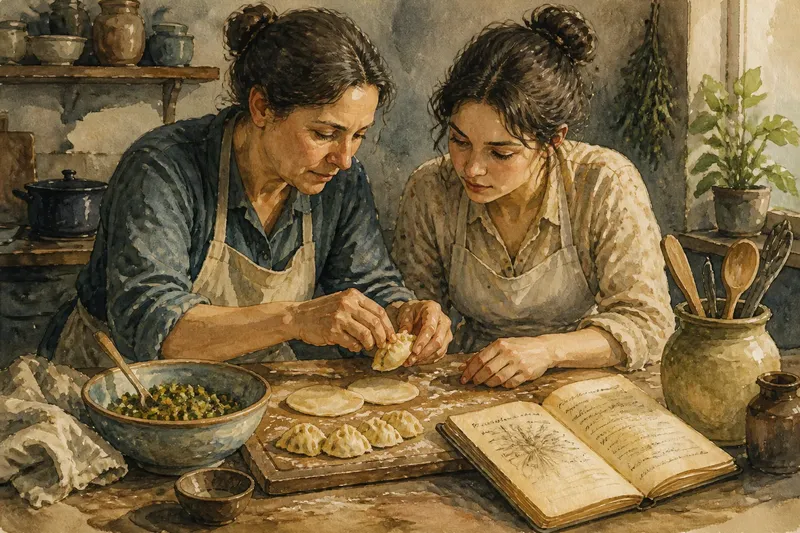
The common mistake in imagining cooking before cookbooks is to picture people working without instructions. That leaves out the person beside the stove, the familiar pot, and the practiced cues a learner could observe. Before a recipe was written down, cooking knowledge could travel through shared work, though the ways people learned varied by household, place, and period.
Demonstration, memory, conversation, and writing could overlap rather than replace one another. Each carried different details, and each left some knowledge to be supplied by the cook.
Watching made technique visible
A learner standing beside a cook could see decisions a short instruction might skip: how finely to chop an onion, how steadily to stir, and what a pan looked like before the next ingredient went in. The teacher could slow down, point to a change in texture, or answer a question as the work unfolded.
Some actions are hard to describe precisely. “Work the dough until it feels right” becomes more useful when a learner can press it, watch how it responds, and compare the result with the cook’s example. Demonstration can also make pace and sound easier to notice.
Watching once is not the same as knowing. The learner needs a turn to repeat the action and make a judgment. Close, shared work leaves room for correction; a performance from across the room may not.
Repetition gave memory useful landmarks
Someone learning beside a relative, neighbor, or other cook could become familiar with a task’s order and its cues. Memory might hold when to add liquid, what a mixture should look like, or when a dish seemed ready to move to the next stage.
That memory did not have to work as a fixed script. A cook might adjust to the ingredients at hand, the vessel, or the number of people expected. Repetition could help a learner recognize the usual pattern, but it did not make every change safe or appropriate.
For a new learner, ask the person teaching to pair each action with something observable. “Stir until glossy” offers a clearer landmark than “stir for a while.” If the cue is uncertain or varies between cooks, record that difference rather than turning one version into a universal rule.
Spoken instruction depended on relationships and access
People could carry food practices through family ties, work, migration, markets, and shared meals. A dish might be taught as a sequence, a seasonal habit, or a story about who made it and when. As cooks encountered different ingredients or tools, a method could change.
Conversation gave learners a chance to ask why a step mattered. A teacher could explain that an ingredient went in late to preserve its aroma, or that a pot needed frequent attention because food tended to catch. Such reasons help a learner make a considered adjustment instead of copying a motion without understanding it.
Access was not automatic. If the person who knew a method was unavailable, or if no one had time to teach, a learner might not acquire it. Passing along a dish required both someone willing to show the work and someone able to learn it.
Written recipes preserved a version of the method
A household note, manuscript, or printed cookbook could carry instructions beyond the presence of the cook who wrote them. A text might preserve ingredients, order, and preferred choices, making it possible to revisit a method or share it beyond the immediate kitchen.
Some written instructions assume that readers already know basic techniques. They may name an action but omit timing, heat, vessel choice, or signs of doneness. Even a detailed recipe cannot fully convey the feel of dough or the moment a sauce thickens.
Read a written recipe as one record of a method, not necessarily the whole lesson. A margin note such as “lower the flame” or “needs more time” can add a useful cue, especially if it identifies what the cook observed before making that adjustment.
Text and practice could clarify one another
A recipe could supply a sequence, while demonstration showed an unfamiliar motion and repeated practice helped a learner notice changes. These methods could be used together, but the combination did not make every instruction complete or every household’s version identical.
Imagine a learner has a handwritten dumpling recipe that says to seal the edges firmly. The learner asks a relative to demonstrate one dumpling, then makes another while noting how the filling sits and how the seam feels under the fingers. The learner adds a description of the dough’s texture beside the written instruction. On a later attempt without the relative present, the note offers a cue to check, while the seam and filling provide visible and tactile signs for deciding whether to adjust the method.
To preserve a recipe, write down the ingredients and sequence, then add the cues a learner would otherwise have to guess: what the mixture looks like, what sound matters, and what can be adjusted. If cooks remember different versions, identify whose version each note describes. If a detail is uncertain, mark it as uncertain.
How did cooks pass recipes along?
Were recipes taught before cookbooks existed?
Cooking instruction could travel through observation, practice, conversation, and memory, as well as through written records. A learner could acquire a method from someone working beside them without consulting a cookbook.
Why do old recipes leave out details?
Some instructions assumed readers knew familiar techniques and could judge doneness for themselves. A brief note might make sense to an experienced cook while leaving a new learner unsure what to look for.
Can a written recipe capture a cook’s full method?
It can preserve ingredients, order, and useful observations, but it may not convey touch, pace, or every visible change. Demonstration or specific sensory notes can help fill those gaps.
What should I record when preserving a family recipe?
Keep the ingredient names, sequence, and quantities the cook actually uses, then ask about texture, heat, timing cues, and substitutions. Name whose version it is and note differences rather than presenting one account as universal.
Not every remembered dish needs a polished card with exact measures. Trying to force certainty onto a flexible family method may take more effort than it returns. For a recipe you want to pass on, record one clear cue that helps a learner decide what to do next; it may be more useful than a longer list of steps.