The Curve of a Wooden Spoon: Form, Grip and Stirring
Choose a wooden spoon by matching its bowl, edge, and handle to your cookware, so stirring feels controlled and food is easier to move from pan to pan.
The common mistake when choosing a wooden spoon is judging it by length alone. A handle may reach across a pot comfortably, yet a bowl that is too broad or shallow can still make a thick sauce awkward to stir. Match the bowl, edge, and handle to the pots and mixtures you use, and the spoon will feel easier to guide.
The bowl controls what the spoon gathers
The bowl’s width, depth, and outline determine how much food it moves and how it releases it. A broad, shallow bowl sweeps a large area. It suits loose soups and folding soft ingredients, but can push a thick mixture ahead rather than turn through it.
A narrower, deeper bowl gathers less at a time and gives more control over dense food. It can draw a path through risotto or thick sauce without moving a heavy mass all at once. In a large pot of broth, that same shape may feel slow because it moves less liquid with each pass.
A pronounced hollow carries liquid and can lift food from the bottom. A nearly flat bowl is better at sweeping a surface, but holds less when you want to taste or serve a spoonful. Decide whether you mostly need to gather, turn, or sweep.
The edge determines how the spoon meets the pot
A rounded edge glides easily over curved surfaces and is less likely to catch when you change direction. A thinner, flatter edge can press closer to a pan’s bottom, helping lift a film of sauce or softened ingredients. A blunt edge may leave food in the seam where a shallow pan’s base meets its side.
The bowl’s outline matters too. A tapered end can reach into that seam, while a broad oval suits open, steady sweeps. For a round-bottomed saucepan, an oval bowl with a gently narrowing end can cover the middle and still reach around the curve.
Use enough pressure to move food, not so much that your wrist bears down on the spoon. With delicate cookware, follow the maker’s utensil guidance. Let the edge follow the vessel instead of levering against a stuck patch.
The handle connects your grip to the bowl
A longer handle gives your hand more room from the heat and can help you reach into a wide pot. A shorter handle may feel nimbler in a small saucepan. Too much length for the task can make even a light spoon awkward near the rim.
A round handle rotates naturally between your fingers, which helps when you need to change the bowl’s angle. A flatter or oval handle makes its orientation easier to sense. A slick finish can be difficult to hold with damp hands; a rough surface may feel abrasive and collect residue. Hold the spoon as you would while cooking, and notice whether you can adjust your fingers without clenching.
A straight handle gives a direct push. A slight bend can help the bowl sit flatter against a pot’s bottom while your wrist stays relaxed. The effect depends on your grip and cookware: a spoon that works in a deep stockpot may put your wrist at an awkward angle in a low skillet.
Match the spoon’s movement to the mixture
For thin liquid, broad circles can keep ingredients moving through the pot. For thick sauce, sweep slowly across the bottom and around the sides; fast circles can leave settled food behind. For a soft mixture that should keep its shape, use a wide, shallow stroke from the outside toward the center.
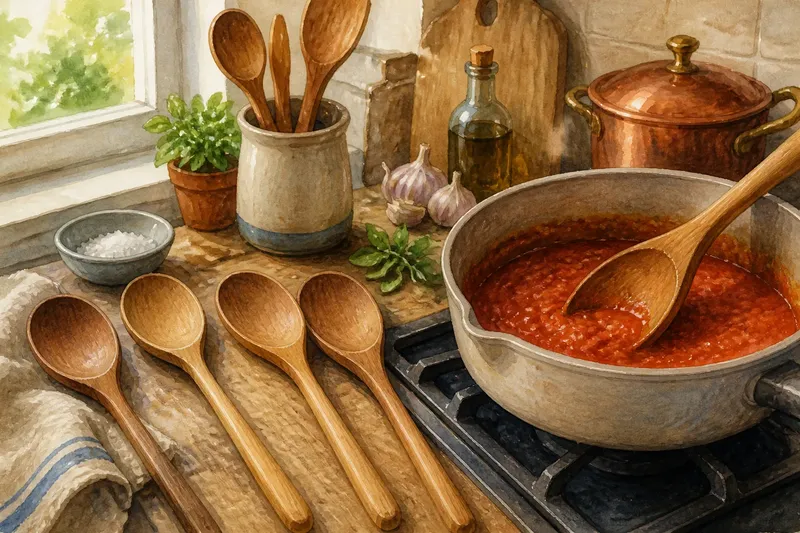
Imagine you are making thick tomato sauce in a small, round saucepan. The starting point is a sauce that catches in the curved seam at the base. Use a narrow oval spoon with a tapered end to trace the seam, then lift the sauce toward the center. You should see the band of sauce move into the main mixture; with a broad, flat spoon, the middle may clear while some sauce remains at the edge. That difference helps you decide which shape suits this pan and task.
For sticky foods, a hollow can help gather a portion for turning, while a flatter edge can release food that has adhered to the bottom. For delicate custards or grain dishes, use a rounded edge and a light hand. If the mixture resists, ease the pressure, change direction, or choose a bowl that moves through it more easily.
How do you choose a wooden spoon?
Which bowl shape works for everyday stirring?
A medium oval bowl with a moderate hollow can carry some liquid while still sweeping a pot. If you often cook thick mixtures, choose a narrower outline or a more defined edge; for soups and loose sauces, a broader bowl may feel easier to use.
Does a wooden spoon need a flat edge?
No. A flatter edge can reach close to a pan’s base, while a rounded edge changes direction smoothly and suits curved vessels. Choose according to your cookware and how often you need to scrape the bottom rather than simply move food around.
How can you tell if the handle fits your grip?
Hold it with your usual cooking grip and make a slow stirring motion in the air. Your wrist should turn the bowl without your fingers pinching hard or the handle rolling unpredictably.
What is the difference between a spoon and a wooden spatula?
A spoon’s hollow gathers and carries food as well as stirring it. A wooden spatula usually has a flatter, broader face for turning or scraping, so it can suit shallow pans but is less useful for lifting a spoonful of liquid.
Inspect the spoon against your cookware
Use these checks with a pot or pan you regularly use. Each result points to a practical choice rather than a universally best shape.
- Check the bowl depth: If you often lift broth or sauce, choose a bowl with a visible hollow; if you mostly fold or sweep, choose a shallower bowl instead.
- Look at the rim: If food often clings to the pan’s base, choose a flatter edge; if you mostly stir around curved sides, choose a rounded edge instead.
- Inspect the outline: If food settles in the seam where the base meets the wall, choose a tapered end; if you mostly stir in an open area, choose a broad oval instead.
- Hold the handle: If it rolls or makes you clench, choose a flatter or oval grip; if it stays steady and turns easily, that handle shape suits your hand.
- Compare the spoon with your cookware: If it reaches the bottom while your wrist stays relaxed, keep it in consideration; if you must stretch or twist, choose a handle and bowl better suited to that vessel.
- Inspect the surface and care directions: If the finish is smooth and intact and the maker’s washing guidance fits your routine, the spoon is a reasonable candidate; if it is rough, damaged, or difficult to care for, choose another.
There is little value in buying a specialized spoon for every recipe or debating tiny differences in bowl shape before you have noticed how your usual spoon behaves. Start with the pot and mixture that make stirring awkward. One well-matched tool is often more useful than a drawer full of similar handles.
Let the spoon follow the vessel
When choosing a wooden spoon, pay attention to how its edge meets the pot, not just how it looks on a hook. The bowl controls what it gathers, the edge sets how closely it follows the vessel, and the handle determines how comfortably you can guide it. A spoon that suits your cookware lets you stir with a lighter hand and see where the mixture is moving.
Use the main search phrase, wooden spoon, as a reminder to think about movement rather than appearance: match the bowl and handle to the path you need, then check that the spoon can reach the places where food tends to settle without straining your grip.