Open Shelves or Closed Cupboards? Two Ways to Keep Kitchen Objects
Open shelves or closed cupboards? Compare visibility, visual order, dust, and access to choose kitchen storage that suits your habits and room.
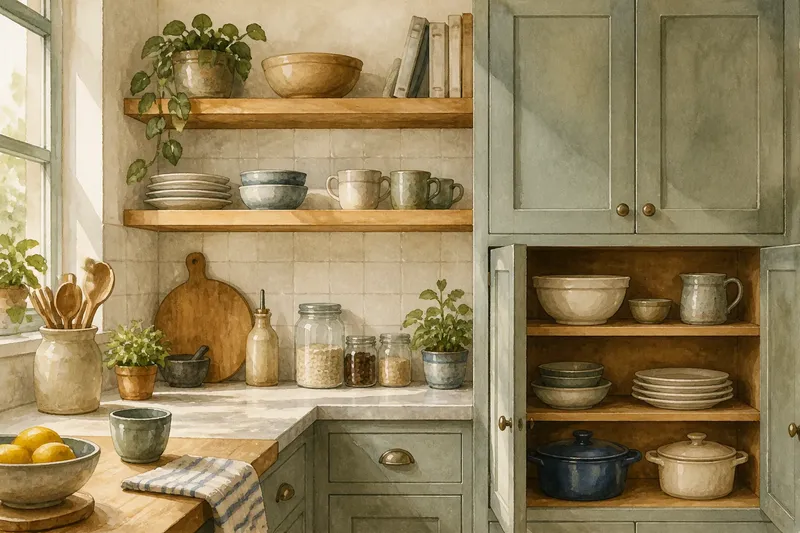
The most common mistake with open shelves or closed cupboards is choosing by appearance alone. The cost is a kitchen that looks tidy in a photograph but makes everyday objects harder to find, clean, or put away. Open shelves and closed cupboards solve different problems: one displays what you keep, while the other conceals it.
The useful question is not which option looks better in general. It is which objects you want to see, how much visual activity feels comfortable, and what kind of order you can maintain on an ordinary day. Many kitchens benefit from using both.
What is the practical difference between open shelves and closed cupboards?
Open shelves keep objects visible and within easy reach; closed cupboards hide their contents behind doors. That difference affects what you notice, what you need to arrange, and how quickly you can locate a particular bowl or jar.
A shelf makes its contents part of the room. A row of everyday plates can look calm and useful, but assorted packets, spare containers, and rarely used gadgets can make the same stretch feel busy. A cupboard softens that visual activity. You see the doors rather than every object, though you may need to open them and look inside to find what you want.
Think of storage as a choice about visibility, not simply capacity. Both arrangements hold kitchen objects. They ask for different habits in return.
Do open shelves make a kitchen feel larger?
Open shelves can make a wall feel less enclosed because there are no solid doors across the stored objects. They can also make a kitchen feel more crowded if the contents create a scattered pattern or extend across too much of the wall.
The effect depends on what the shelves hold and where they sit. A short shelf with a few frequently used dishes may leave the room feeling light. A long run packed with mugs, jars, cookbooks, and small appliances may draw the eye to the entire collection. Closed cupboards create a more continuous surface, which can make the room feel visually settled even when the cupboards are full.
Notice the wall from the doorway and from the place where you usually prepare food. If the objects interrupt the view or compete with a busy backsplash, a closed front may suit that area better. If a blank wall feels heavy and you have a small, coherent group to display, a shelf can break it up.
Which storage is easier to keep visually orderly?
Closed cupboards are easier when you want the room to look composed without arranging every object for display. Open shelves can look orderly too, but the order has to come from the visible contents and the way they are returned after use.
For an open shelf, choose a clear purpose. Keep one shelf for plates and bowls, or reserve a short section for mugs used each morning. Leave some open space rather than filling every gap. Repeated shapes can help the group read as one collection, but there is no need to replace useful objects just to make them match.
For cupboards, group items by task or type so their hidden arrangement remains easy to use. Put daily dishes together and keep less-used serving pieces in another area. A door conceals clutter from view, but a disorganized interior can still slow you down.
Say you reach for the same breakfast bowls each day but use a serving platter only for occasional meals. Keeping the bowls on an accessible open shelf and the platter inside a cupboard gives the bowls a visible home while keeping the less-used object out of the daily scene.
Do open shelves collect more dust and kitchen residue?
Objects left on open shelves are exposed to room dust and, depending on their location, cooking residue. Closed doors shield stored items between uses, so shelves require more frequent attention than cupboard interiors in many kitchens.
Exposure varies with the shelf’s position. Storage near a range or a spot where oil and steam travel may need more frequent wiping than a shelf away from the cooking area. Objects used often are handled and washed regularly; decorative pieces or seldom-used dishes can sit undisturbed longer.
Keep open storage for objects you reach for often and are comfortable cleaning. Put rarely used pieces behind doors, especially if they are awkward to wash or difficult to move. This is a practical division, not a reason to avoid shelves altogether.
What is not worth the effort is arranging a shelf so carefully that ordinary cooking becomes a performance. If putting a bowl back requires preserving an exact display, the storage is working against your routine.
How should I choose between shelves and cupboards?
Choose by the job each storage area must do, then test the choice against your habits and the amount of visual activity you want. Use these questions to decide where each kind belongs:
- What do I use most days? Consider open storage for frequently reached dishes or cups, if keeping them visible feels comfortable.
- What do I want to hide? Choose a closed cupboard for mixed supplies, spare pieces, or objects that make a wall look busy.
- How much do I want to clean? Favor doors for items that sit unused or would be inconvenient to wipe often.
- Does the wall already feel crowded? If it does, a continuous cupboard front may bring more visual order than another display surface.
- Can I put items back easily? Pick a location and arrangement that match the route you take while cooking, not just the view from across the room.
- Would a combination work better? Keep a small daily-use group visible and store the rest behind doors if neither option suits everything.
For a low-commitment trial, clear one existing shelf or cupboard section and use it for a defined group of objects. Pay attention to whether you reach for the items comfortably and whether the area still looks acceptable after normal use. If you are changing fixed cabinetry or installing shelves, follow the product instructions and any applicable local requirements.
Can a kitchen use both open shelves and closed cupboards?
Yes. A mixed arrangement is often the simplest way to keep useful objects accessible while limiting what remains in view. The two types do not need to be balanced evenly or arranged as matching pairs.
Place open storage where visibility helps: near the area where you use everyday mugs, bowls, or glasses. Use closed storage for items that are numerous, visually varied, or needed only occasionally. In a small kitchen, even one short shelf can provide access without turning an entire wall into a display.
Avoid treating the shelf as a place for whatever does not fit elsewhere. Decide which objects belong there and keep the rest in cupboards. That boundary preserves the shelf’s purpose and makes it easier to return things after use.
Do kitchen objects need to match on open shelves?
No. A shelf can feel coherent without a matching set if its objects share a useful role, similar scale, or a sensible arrangement. The aim is not uniformity; it is making the visible group easy to read.
Try grouping objects by use: daily plates together, mugs together, or a few jars used for cooking in one place. Varying shapes and materials can add character, but too many unrelated categories packed into one narrow area may create visual noise. If you like the objects but dislike the overall effect, move some behind a cupboard door rather than replacing them.
That choice also keeps the storage honest. A shelf is allowed to show signs of daily life, provided you can find and put away what you use. A cupboard is useful precisely because not every working object needs to be part of the room’s view.
Which choice fits the way I want my kitchen to feel?
Choose open shelves if visible objects make the kitchen feel personal and you are comfortable maintaining their arrangement. Choose closed cupboards if you prefer calm surfaces and fewer things in view. Combine them if access and visual quiet matter in different parts of the room.
Before deciding, look at the objects you actually own rather than imagining an ideal collection. Notice which ones are used often, which ones you enjoy seeing, and which ones create visual clutter. The right balance can change as your routine changes.
For open shelves or closed cupboards, the most useful measure is whether the storage supports both the work and the atmosphere you want. Keep the things you reach for where you can find them, conceal what you would rather not see, and leave enough room for the kitchen to feel like a place to cook rather than a display to maintain.